
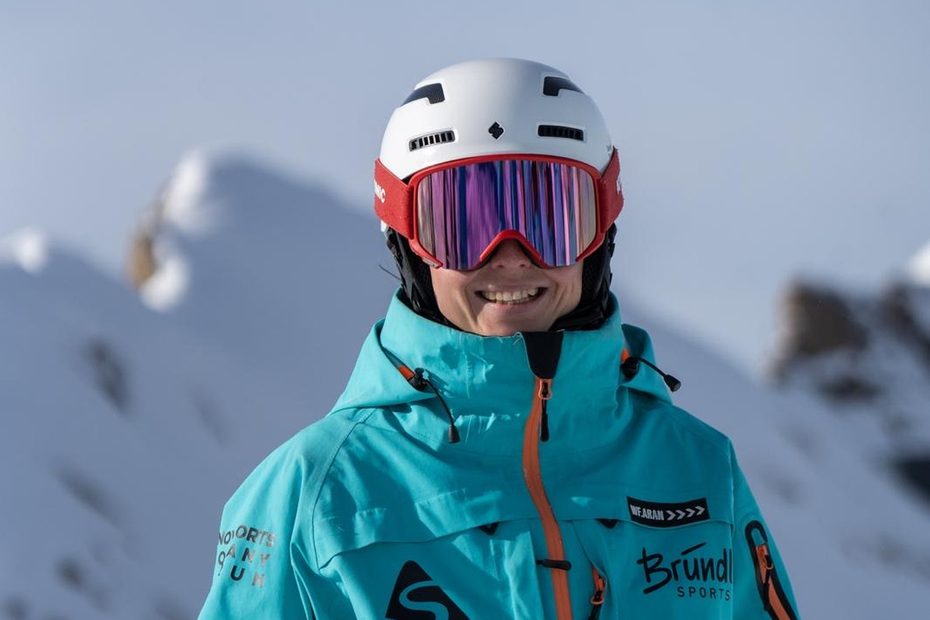
“Liepkalnis was my backyard,” Ilze begins, and that one sentence explains almost everything that happened later. The girl who skied after school until the hill closed now lives in Austria, prepares instructors for their exams and leads technical skiing camps. She is a qualified Level 3 instructor of the Austrian Vienna association and of LSIA, and also a PSIE trainer and examiner. She knows the inner working culture of Austrian resorts well, has experienced a summer season in New Zealand and a Japanese winter, and this year is counting her tenth season working in the mountains. But let’s start from the beginning.
I am sitting in a kitchen across from Ilze Cibulskaite. We are drinking tea, because the 1st of November in Sölden turned out to be bitterly cold. Today we both skied together with the instructors attending the LSIA Level 2 course: Ilze is studying so that in the future she can become an LSIA examiner too. But her story begins on another, smaller hill that many people know well. I listen to her and picture a little girl going round and round at Liepkalnis, feeling neither hunger nor cold, because she simply loves it. So much that she cannot stop.
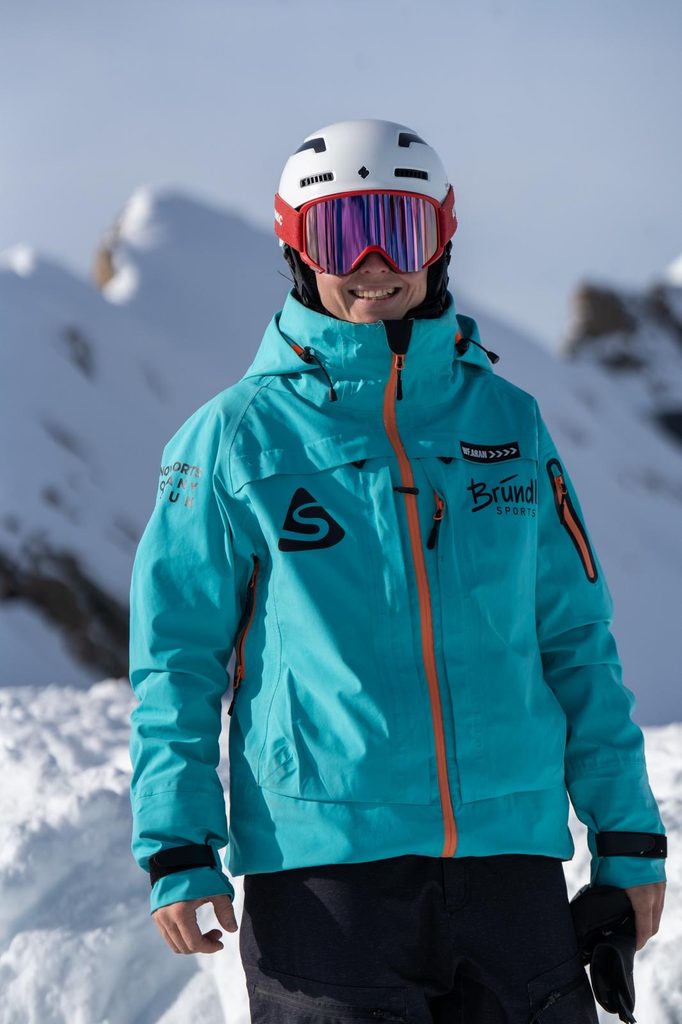
A childhood backyard with ski lifts
Liepkalnis, the Vilnius ski resort, was right next to Ilze’s home. Her parents skied, so at about the age of three the little girl was put on skis too. “My parents had learned to ski themselves, the ‘Lithuanian way’: you walk up the hill and come down on long, thin mountain skis with no edges. That’s how all of Liepkalnis skied then,” Ilze remembers.
At that time Laimis Janutenas, a skiing enthusiast who had built his own hill in a country without mountains, used to “borrow” electricity from her parents’ house to run the lifts. To thank them, from about the age of five he started teaching Ilze to ski himself. “He showed me the pizza (snowplough), showed me how to turn the skis – that was my ABC!” Laimis often took Ilze along skiing later, too.
“I would go round and round the whole hill, every day after school until closing and every weekend. Sometimes I didn’t even go home for lunch!” Ilze says. Nobody forced her, and her parents, even though her school grades suffered, didn’t stop her: “I’m so glad they were understanding and let me ski.”
She remembers the same faces on the hill, mostly older men who came to ski after work. “And I, an eight-year-old girl, skied with them! I knew all the old-timers and we talked a lot.”
First mountains and last competitions
In 2007 she went skiing in Italy with her family for the first time. Ten-year-old Ilze only then tried on a helmet: “Until then, at Liepkalnis a thicker hat was enough,” she laughs. The real mountains blew her away. She vividly remembers crying bitterly when it was time to leave.
When she got back, she wanted only one thing: to ski even more. And she did. Not even her kneecap, which would pop out from time to time, got in the way. In the end, without getting proper help from doctors, Ilze worked out for herself exactly which muscle holds the kneecap in place and began strengthening it on her own. “Once the muscle got stronger, all the problems ended.”
At fifteen she asked her dad to call a ski club and ask them to take her for training. That is how slalom began, with training at the Druskininkai arena, trips to Finland, and later to Italy with the Kronplatz Racing Center. Having watched Lindsey Vonn, she seriously thought about a racing career.
Still, competitions were torture for her: “I got very nervous, but the training itself I loved endlessly. In the end I realised that I care about the skiing itself, not the results.” After finishing school Ilze quit training and didn’t touch skis at all for a year.
I ask what she did during that year. All I get back is a good burst of laughter: “What didn’t I do! It wasn’t me living life, it was life living me. But after such a fun year I pulled myself together and asked myself seriously: what makes me happy? The answer was clear: skiing.”
Having realised this, Ilze went back to the mountain, only this time not Laimis’s.
Ski instructor course – job guaranteed
As a child, the Liepkalnis old-timers had told her that instructors abroad could earn quite well. That thought came back now, and the job search took only a few seconds.
“I just typed ‘ski instructor course’ into Google. On the screen I see: ski instructor course – job guaranteed. And I bought it!” Ilze says simply, as if she had just bought a pair of socks and not a course in Austria.
True, she also dreamed of Canada, having watched how beautifully everyone skis off-piste there. “But my mum advised me to start closer to home. I took her advice, and no visa was needed either. My parents, as always, supported me: they understood that what matters most is doing what brings me happiness.”
The training in the Alps was in English, while the exams were in German. She hadn’t liked German at school, so she never studied it seriously: she was sure she would never need it. “The courses weren’t cheap, so the thought that I might fail didn’t even occur to me! The hardest part was the German, but I studied stubbornly every evening and somehow it all worked out. I passed the exams the first time and got a Level 2 qualification in the Austrian system.”
The promised guaranteed job for Ilze was at the Jochberg resort. “The resort itself is very small, just a few lifts, but it’s connected to the big Kitzbühel. We instructors were housed in an old police station, with lots of bunk beds crammed into the offices. Sounds suspicious, doesn’t it? But it was everyone’s first season and, honestly, it was a lot of fun.”
What sounds far more suspicious to me is that for half the season Ilze and the other instructors were not officially registered as working in Austria, and the boss paid wages in cash, in a conference room at a big table.
“It was something else… You come in, and he puts banknotes on the table one at a time, counting your wage out loud: one hundred, two hundred, three hundred, four hundred, five hundred… When he finished counting, he took the same pile, counted off part of the sum for himself and said: ‘You owe me this much, and here is what’s left for you.’ Then he called the next person, and so on, one by one,” Ilze recalls.
She later found out it was one of the worst schools in Austria. She earned little, but in her first season that wasn’t what mattered most to Ilze. She was doing better than many: as one of the school’s better skiers she got the very best clients, so she skied a lot, taught them higher-level technique and gained useful experience.
She counts the school itself as good experience too: “Now I know how it can be, and I know it can be better. That system persists because young people who don’t know the laws work there, and turnover is high: if you leave, three others will certainly turn up in your place.” So her advice is simple: if you don’t like the school, don’t go back. You will definitely find a better job.
Obergurgl: Kinderland and the princess
The following season she was hired at the Obergurgl resort. This time the school was reliable – in her words, one of the best in all of Austria – but a cold confrontation with reality came right away: “Nobody cared how I skied: I’m a girl, and I also spoke German poorly.” So she was assigned to Kinderland (the children’s ski kindergarten) for the whole season. When she asked her boss for other work, the answer was “no”.
Ilze calls Kinderland the hardest job: “You spend the whole day in ski boots and a helmet while barely skiing – you haul around your eight little ones, who cry and try to run away. Of course, it’s not a bad job in principle, but working it every single day all winter really wears you out.”
Ilze’s way up took two years, whereas the guys who arrived for their first season would immediately get the best jobs. In Austria there is a “boys’ club” that a girl doesn’t automatically fit into. But the discrimination is felt in more painful ways as well: she heard more than one story about harassment, even rape. “What’s worse, nobody in the system deals with these problems. I don’t know about elsewhere, but in Austrian resorts there is definitely a lack of equality for women. To achieve anything, you have to be very resilient and persistent.”
Her senior colleague at the school advised her not to lose heart but to keep trying: learn the language, work conscientiously, always be prepared. And in the end Ilze got lucky: once, when somebody fell ill, she was asked to teach a group of better-skiing children. The school liked her work, and so Ilze stayed in the new position.
“From then on my seasons at Obergurgl became fun, I felt like a princess! The same teenagers skied in my group, coming back every year to learn here. Honestly, I skied with them whatever I wanted to improve myself. I want to improve my short turns – let’s go short! I want to improve my mogul technique – let’s go to the bumps with the group.” The children, according to Ilzė, loved the lessons, and her own level grew too.
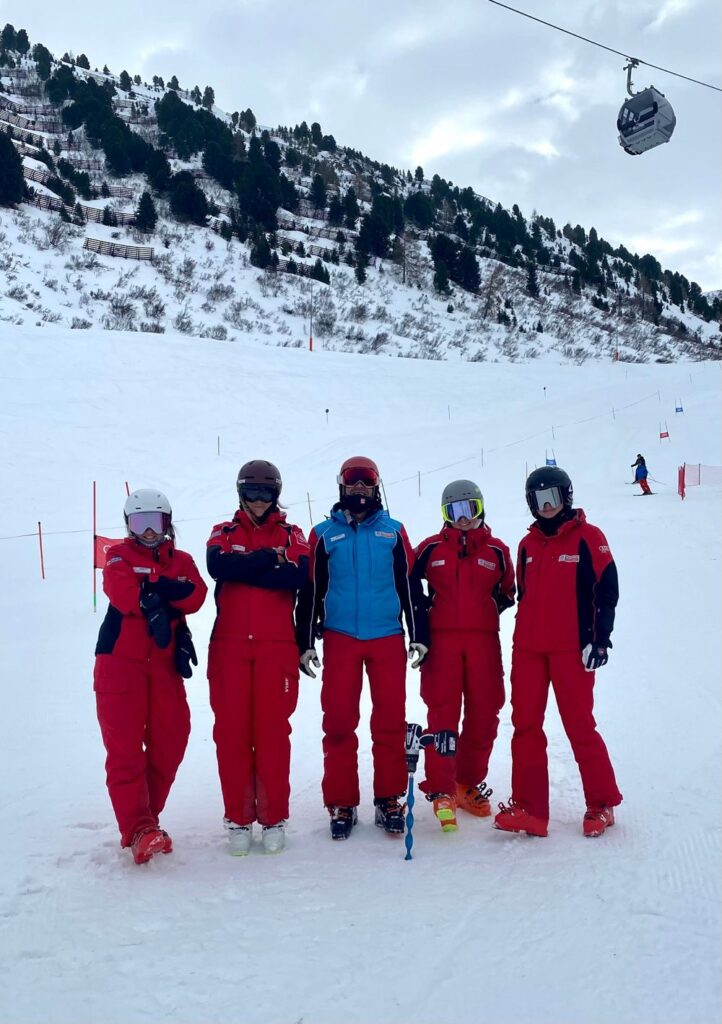
To everyone preparing to work in Austria, Ilze advises that in the first season you have to earn your place. “The school may be excellent, but nobody trusts you because they don’t know what you can do. If you’re never late, look presentable and are always ready to work, you can make your way.”
St. Anton, the demo show and covid
Ilze became convinced that the Obergurgl school deserved its good name, so she worked there for five years in total. In between she tried the St. Anton resort, but she didn’t like it because it is much lower: “The season there is shorter, with less snow. I remember that in St. Anton it rained in December, while in Obergurgl it would have to be May for that.”
The season in St. Anton ended unexpectedly: during a night performance by the demo team, Ilze partially tore the anterior cruciate ligament in her left leg. As if that weren’t enough, that was the very year the global COVID-19 pandemic began, and St. Anton ended up in the red zone. Her boyfriend drove her, on crutches and not very mobile, back to Lithuania.
“I remember seeing on a TV in some McDonald’s in Germany that all the borders were closing. We were very lucky, because right after we crossed the Lithuanian border, they closed that too.”
She spent the next winter in Lithuania, glad of the rare chance to celebrate Christmas with her family. She couldn’t ski until May. Doctors said surgery on the knee wasn’t necessary, and Ilze decided not to have it.
When the resorts reopened, she went back to work in Obergurgl. There were few clients and everyone skied in masks, which I think we all remember well.
And the year after that, Ilze tore the same ligament completely. “That day I was already tired, but in the evening I was tempted to go skiing in the bumps with friends. I jumped over a small mogul to get back onto the run, but I caught an edge: one ski released, the other didn’t. I immediately understood the situation was bad and that this time I would definitely need surgery.”
After a successful operation in Austria she was lucky with her physiotherapist, too. So that year she spent the whole summer in the Alps, in the Ötztal valley, where she rehabilitated, worked and got stronger. The next season she was skiing again, with, as she herself says, “an even prettier right turn than before”.
The New Zealand conveyor belt and the Japanese miracle
Most people probably dream of spending at least one summer season on skis. Ilze chose New Zealand, but she didn’t like working there: “In Europe skiing is about the skiing itself, while in New Zealand it seems to me that for most people the main thing is to tick the box that they were here and skied.” Every day a new group of beginners was waiting for Ilze: “It’s a conveyor belt, and there’s little snow too,” she says.
Still, the season there was useful, because Ilze passed NZSIA (New Zealand Snowsports Instructors Alliance) Level 1, which also helped her get an employer-sponsored visa for Japan.
A winter in Japan, unlike the summer in New Zealand, left an indelible impression on Ilze: “I had to pinch myself every day to make sure I was really here!”
She worked at the famous Niseko resort, at the Hokkaido Collective school, which sold only premium private lessons and whose head is a well-known ski instructor.
The school also gave two instructors a car each so they could drive their clients, but allowed them to use it for personal errands as well. “We drove to the sea and to towns, we saw quite a lot. Of course I loved the snow, but also the work, the culture, and the food! I still dream about Japanese ramen today. Unfortunately, in Europe you rarely get the real thing, not the kind boiled from a stock cube.”
Still, she wouldn’t want to work a second full season in Niseko, because the resort is heavily overcrowded. “I’d definitely like to go back to Japan, but maybe to a smaller resort and not for the whole winter.”
She also wouldn’t want to work two seasons in a row, winter and summer (as in New Zealand). “I need warmth, sun, lakes. And my body needs time to rest. After all, your legs and knees have an expiry date! And I want to ski for a long time yet… right up to old age.”
So in summer she trains and strengthens her body in the gym. She likes hiking in the mountains, travels actively and visits Lithuania. “If I do work, it’s only various short-term jobs. For me summer is first of all a time for rest and recovery before the new season.”
A new home in Kaprun and the first exams
Today Ilze works at the Kaprun resort, for a company that teaches and prepares ski instructors for their exams. This autumn she is examining PSIE (Professional Ski Instructors of Europe) Level 1 instructors for the first time.
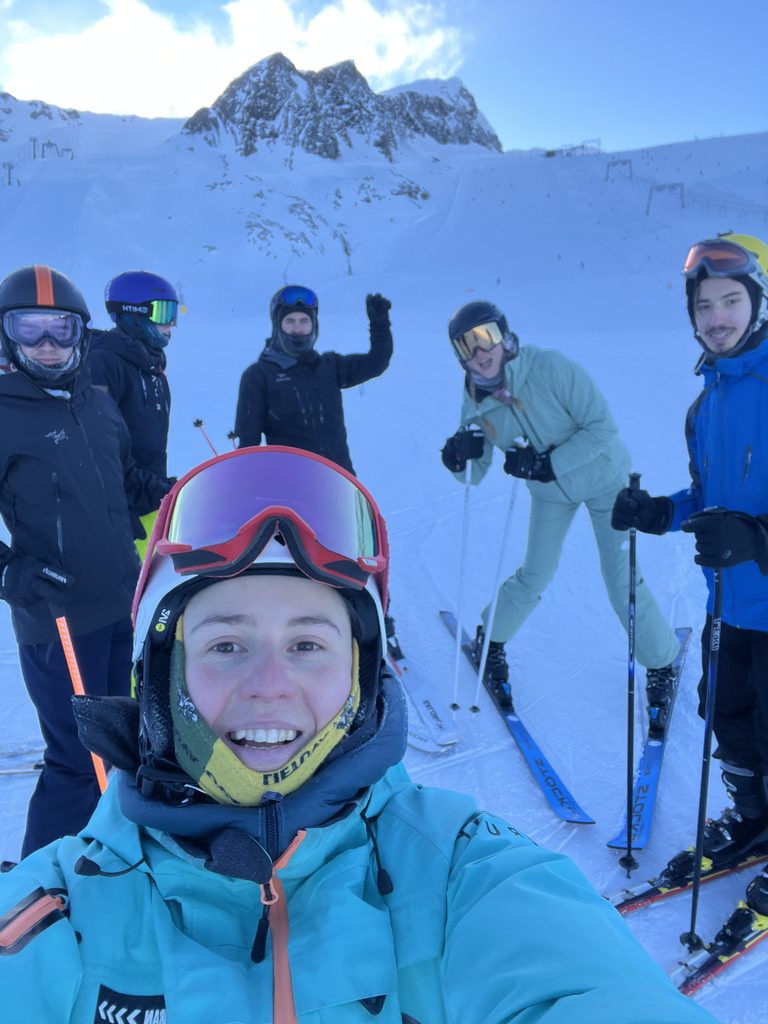
PSIE is a new association uniting Europe and Canada. “It’s more recognised in Canada, while in Europe ISIA still fights against it. Why? There’s a lot of political behind-the-scenes in the skiing world… For example, Japanese schools accept a PSIE qualification, so after the courses people can go and work there too,” Ilze explains.
This winter in Kaprun she is not only preparing future instructors but also, together with her team, leading technical skiing camps for enthusiasts “who want to learn more than just skiing nicely in parallel,” says Ilze.
“Where I work now is a great environment for me to become a better trainer, a better instructor and a better skier.” By the way, she is the only woman in her whole team.
Ilze intends to stay in Kaprun for at least a couple more years: “I’m used to a very unstable way of life, but over time it starts to wear you out. Now that I know I’ll stay in one place for at least a few winters, I feel like a stable, serious woman,” we both laugh.
Perhaps even people who can’t sit still for long need a bit of stability in life.
Austrian and Lithuanian systems: why learn what you won’t need later?
Ilze holds both the Austrian and the LSIA Level 3, which she earned during a refresher course. She skied and talked a lot with LSIA trainers Tomas Mical and Karel Kulhanek. So she can now compare both systems from the inside.
She boldly calls the Austrian methodology conservative: “Their system has a huge gap from reality: instructors with the highest Austrian qualifications don’t ski themselves the way they teach others. For example, at Level 1 they teach that you finish a turn by extending upward, while at Levels 3 and 4 they tell you not to do that anymore.”
Ilze explains that the Austrians present such movements like training wheels on a bicycle for beginners, which can be removed once you improve. Still, she doesn’t much approve of this method:
“Why teach movements you won’t need later? The same goes for short turns: in the exams we had to ski them ‘like with a little broom’, sliding from side to side. That technique may suit old-fashioned skis without modern edges, but the world has been skiing for a long time on modern skis, which work differently. A properly bent ski, like a spring, shoots you into the next turn, and that gives such great pleasure! And it’s efficient.”
Ilze sees that LSIA, by contrast, builds its methodology from the very first steps on the principles of top-level FIS World Cup technique:
“The progression leads you from the snowplough to high-level skiing in gates while keeping the same essential principles. After all, whether you’re a beginner or a racer, your body and skis are the same. So it’s logical that people can be taught correct and efficient movements from the very start, which you won’t later have to tell them to stop doing…”
She likes LSIA also for the freedom to choose your own way of teaching. In her view every person is different, so not everyone suits the same exercise or one way of learning.
“For example, in the LSIA methodology, already at Level 1 you can choose how to teach someone to turn the skis: through weight transfer for those who find it harder, and for more talented ones simply by steering, turning the feet in the desired direction,” Ilze recalls. “But with the Austrians it’s simple! They have one way to teach everybody to turn: the little aeroplane!”
In time Ilze would like to lead courses for LSIA instructors too: “After all, I grew up at Liepkalnis. Even though I don’t work there, I’m Lithuanian from Lithuania, so it would be really good for me to contribute to our system too.”
Quick questions to finish
What separates a good instructor from a bad one? A good instructor is relaxed, and a bad one… is too relaxed.
Favourite drink on the mountain? “Coke Zero. Zero sugar, zero caffeine.” Or water.
Best clients? Those who become friends. I remember one man; we became great friends. He skied quite well, I helped him improve his technique and he stayed grateful to me. And I’m grateful to him to this day, because he gave me really good life advice.
Worst clients? A family where one child is a beginner, another zooms around the blue runs, the mum is afraid of reds and the dad wants to ski only blacks. If you get them all in one group, it’s almost impossible to teach any of them anything. The family suffers too…
Favourite snow conditions? Corduroy (freshly groomed, velvety piste). Powder (fresh, fluffy snow) is only second. After skiing the first morning corduroy run, I start shaking all over.
Dream place to ski? Alaska. By helicopter: “pim pim, up, down.”
What inspires you? Japanese technical skiing is like poetry in motion. Also the women of the World Cup: their strong, precise-to-the-detail technique fascinates me.
If you could no longer ski, what would you do? I would learn to sail. I’d buy a sailing boat somewhere in Croatia and cruise around the islands of the Mediterranean.
Thank you, Ilze.
Thank you! I liked these last questions the best.

